TENAX logo International web site
change
 
  International web site Geosynthetics Soil reinforcement  
 
rilevati paramassi in terra rinforzata
sitemap contact us
 
  Soil reinforcement  

Embankment for rock fall protection

Passive protection structures are typically placed so as to intercept the block's trajectory during movement and fall; therefore the definition of the block motion is of utmost importance for a correct design.


The choice and design of the correct structure of passive protection can be made when the best position, height and kinetic energy to absorb are defined. Among passive protection structures, embankments for rock fall protection have great importance, as they offer the best performances in terms of protection efficiency in comparison to a high-energy absorption wire netting rock protection barrier.

Reinforced soil rock fall protection embankments assure:

  • efficiency of protection even in case of repeated collapses along the same section;
  • reduced maintenance even after large detachment of blocks;
  • long term structure's durability without collapse or decay even further to phenomena such as fires;
  • reduced environmental impact, particularly if the structure is masked with adequate naturalistic engineering work;
  • possibility to re-use previously collapsed or discharge material coming from landslide's alluvial cone.

The evident advantages present in a reinforced soil embankment compared to a traditional structure are certainly: a space saving at the base, an increase in the resistance at the impact with minimum damages, a better energy absorption with minimum possibility of breaking caused by a boulder with high energy.


These two last characteristics can be proved only when referred to a reinforced soil embankment; indeed, in such structures the ground is tied by the geogrids both in the longitudinal and transversal direction of the structure; therefore to break the reinforced embankment, the boulder first shall tear the grids, which however offer high resistance to tensile strength and pullout.


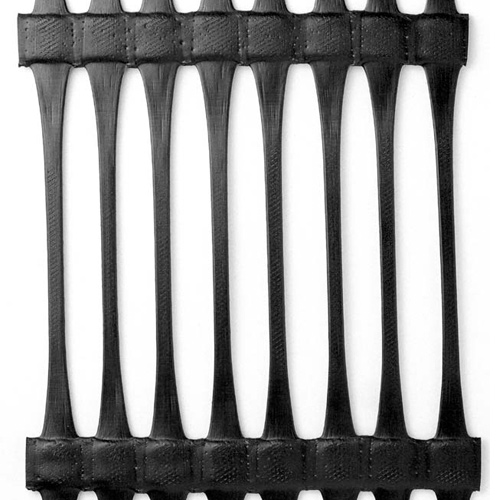
HDPE extruded geogrids TENAX TT SAMP are ideal for such applications as they have an elastic-plastic behavior so that they quickly react to the applied loads with an increase of the elastic modulus, as in the case of an impact therefore the whole tensile resistance of the geogrid can be mobilized.

Geogrids allow an increase of the dynamic dumping characteristics of the reinforced soil compared to soil on its own, both through the energy that is directly absorbed by the geogrid itself and though the "Coulomb dumping effect" due to friction generated in the dynamic stage. A major "confinement" of the ground means a distribution of the dynamic loads on a cone with a larger opening, and therefore a greater mass of soil involved in the resistance to hit and to energy dissipation.

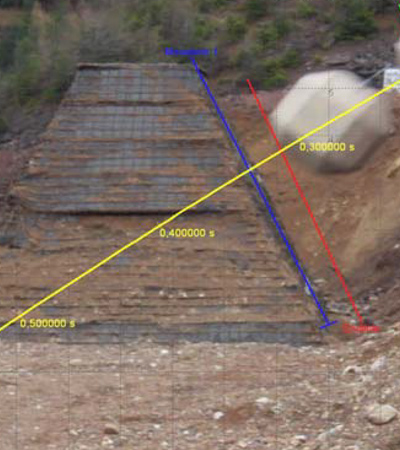
Reinforced ground barriers with TENAX TT SAMP geogrids have been tested in a full scale testing facility accredited by Politecnico di Torino, which, further to such tests, issued a certificate to TENAX Company, attesting the capacity of the barriers to withstand impacts up to 3000 kJ.

Another certificate confirming the test result carried out with an impact of more than 4000 kJ of energy, already performed, will be soon released.

embankment reinforced with geogrids for rock fall protection

embankments for rock fall protection
Embankment reinforced with geogrids for rock
fall protection


The experimentation

testing

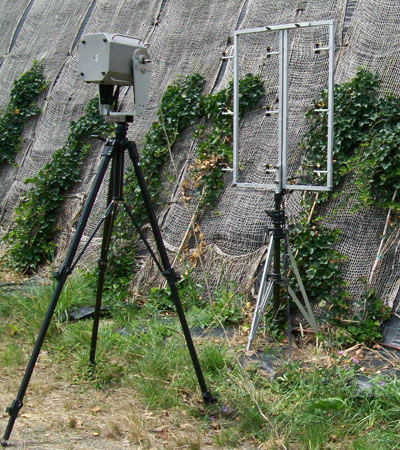
The testing facility was located in a valley where a cableway system enabled cubic boulders to run in semi-free falling for about 50m...


more info


Products

TENAX TT SAMP geogrid

TENAX RIVEL geogrid system and vegetative mat

  TENAX © 1995-2009 All rights reserved