| |

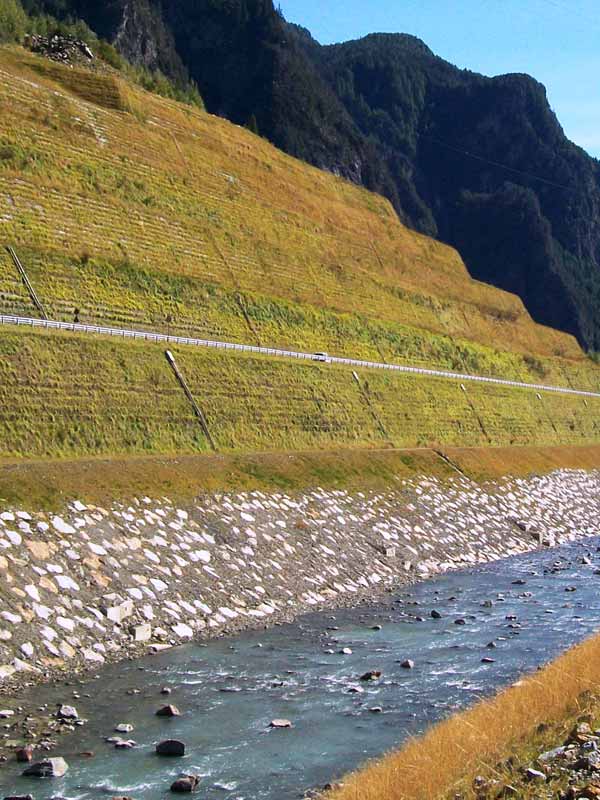
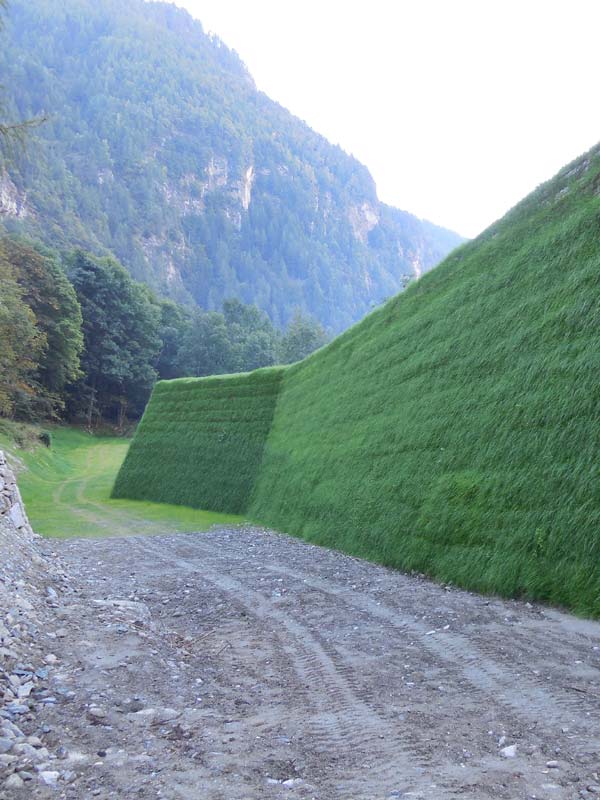
Reinforced slope two months after construction
Problem
In the central part of Taiwan, a housing real estate scheme
required to extend its construction on top of a mountainous
area.
The property owner planned to maximize the usable
land space to fit in luxury villas and townhouses. In order
to create more space for new housing, the engineers had
to consider building a 35 m high wall, about 60° steep,
with 250,000 m³ of excavated backfill soils on a V-shaped
valley.
The fill soil was excavated from a nearby hill. Considered
design inputs were the environmental impact, the aesthetics,
the maximization of usable space and the full utilization
of available on-site weathered shale for backfill soil.
Solution
Several design and construction options were considered
and a cost effective decision resulted in the construction
of a 35 m high geogrid reinforced slope.
The 35 m high wall
consists of a stepped slope with 5 m high partial slopes
at 2:1 (V:H) and 2.5 m wide berms. The main design considerations
included seismic factors, existing backfill, adequate sub-surface
and backfill drainage, vegetation of slope face and increase
of development space.
TENAX TT 601 SAMP HDPE mono-oriented geogrids were selected
for the reinforcement of the weathered shale fill.
The site
is in a sub-tropical rain forest area, where torrential
rainstorms are frequent; therefore the contractor had to
complete the installation within a three months time scale.
The installation system was constructed from timber formwork
fixed in place with wire ropes to achieve the required slope
angle and to support the face during compaction.
The geogrids were fixed in place using U-shaped steel staples
in the reinforced soil block and also on face supported
by the formwork. Vegetation of the face was achieved by
utilizing a pre-seeded straw mat placed inside the face
wrapping length of the geogrid.
To avoid desiccation due
to summer draught at the steep face, a irrigation system
was designed, consisting of flexible plastic pipes (ø
1/2") and water sprinklers, uniformly distributed on
the wall face.
The seepage of the torrential rain water on the face of
the slope was considered critical for the local stability
of the face: hence the seepage flow was collected by horizontal
strips of geocomposite edge drains, 5.0 m long and 200 mm
wide, placed at a horizontal interval of 1.5 m and a vertical
spacing of 1.5 m.
|

Completed face with established grass growth

TENAX TT geogrids installed prior to placing and compaction of fill soil

Placing and compaction of fill soil

View of stepped slope section of face

Stepped face with initial signs of grass growth
Conclusions
The successful completion of the 35 m high geogrid
reinforced soil wall achieved the following objectives:
- low cost, fast construction and easiness to shape the
slopes;
- fast and excellent vegetation of the face;
- excellent stability: after five years of monitoring,
only minimal base and face movements were recorded;
- positive drainage: low pore pressure was noted in the
reinforced block while the culvert discharges a continuous
high flow. Hence this project shows that good geosynthetics
engineering can provide a solution even to extremely difficult
geotechnical problems.
|
|