The goal that the world’s most forward-thinking cities are setting for themselves is to become “nature-positive”—that is, places capable not only of limiting damage to nature but also of restoring space, functions, and biodiversity to it. London aims to restore 40 kilometers of rivers and streams; Copenhagen aims to have 20% of its urban area covered by trees; and Paris aims to complete a biodiversity assessment of its entire municipal territory by 2030. These goals are consistent with the framework proposed by the World Economic Forum to guide cities’ transition toward nature-positive models.
One of the main obstacles to urban biodiversity, however, is the amount of impervious soil that characterizes our cities: asphalt, concrete, and paving that lets neither water nor roots through. Every time a green space is paved over to make room for a parking lot, a piece of the urban ecosystem is lost.
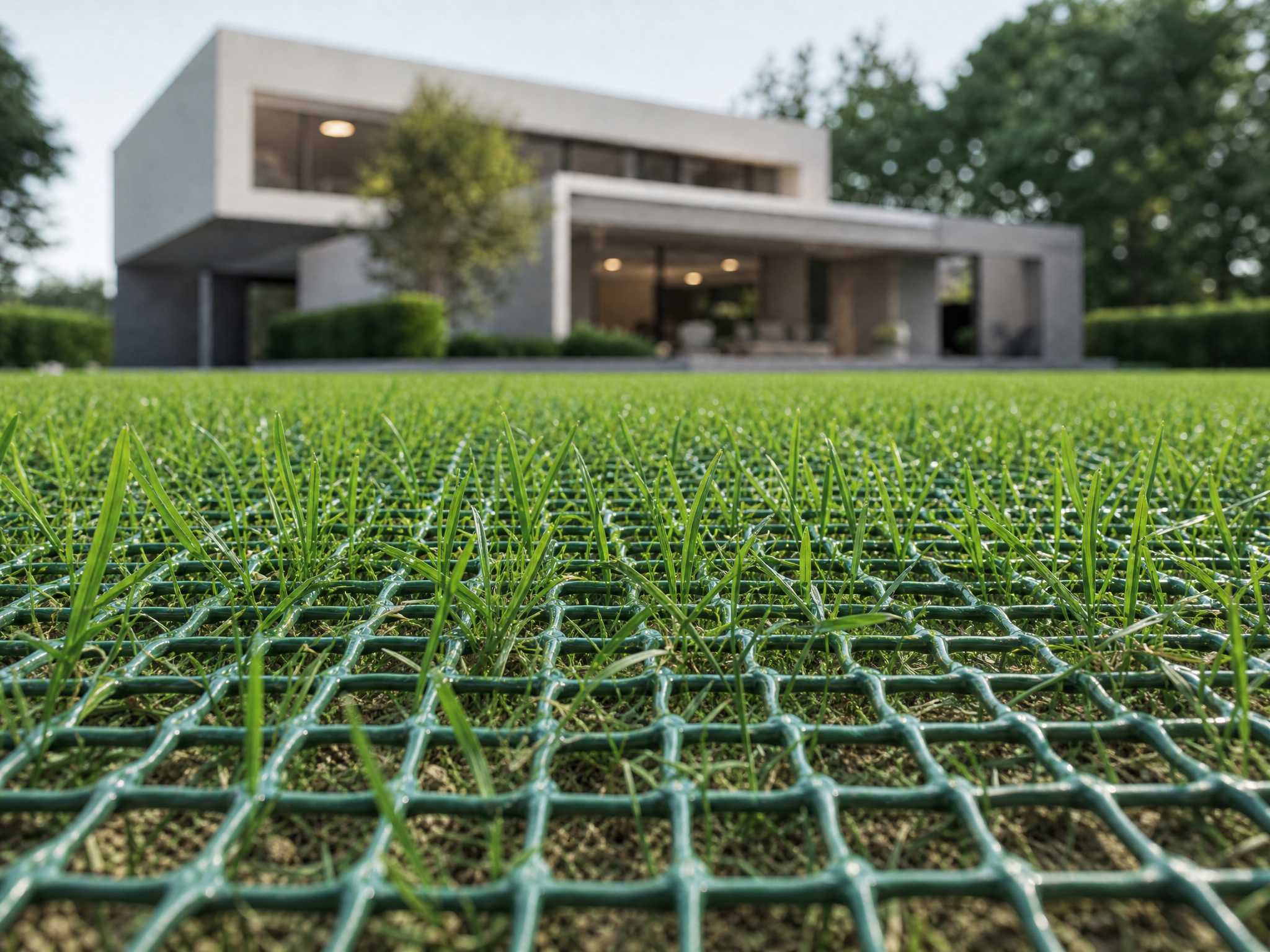
But how can we transform cities into true urban jungles? One answer might be to use technology that reinforces driveable green spaces. The basic idea is simple: instead of sealing the ground, the soil is stabilized while maintaining the grass cover, which remains alive, rooted, and functional. The result is a surface that can support the weight of vehicles without being paved over.
Tenax has developed two products designed for different situations but with the same goal. Tenax TR is a lightweight and extremely flexible high-density polyethylene (HDPE) rhombic-mesh fabric. Its structure ensures effective root anchorage, increasing the turf’s tear resistance under vehicular or pedestrian traffic. It is particularly suitable for areas already covered with grass (existing grass parking lots, green access roads, and temporary event areas such as fairs or concerts) where the goal is to protect and reinforce an existing turf without disturbing the subsoil.
The Network Tenax GP Flex , on the other hand, is the solution for the most challenging situations: areas with soft subgrades, clayey or sandy soils that are not sufficiently compacted, and surfaces that must withstand heavier or continuous traffic. Produced by co-extruding two polymers (HDPE for the structure and EVA to increase traction and reduce vehicle slippage), its “wavy” mesh ensures flatness and flexibility during installation. The product is completely chemically and biologically inert, meaning it does not alter the soil’s normal biological functions—a factor that is by no means secondary when it comes to ecosystems.
The most interesting aspect of these solutions, from a nature-positive perspective, is that they do more than just solve a technical problem—they keep the soil alive. A reinforced lawn is not an artificial lawn: it is a real lawn, with real roots, that retains rainwater, hosts microorganisms, provides habitat for pollinating insects, and helps reduce the heat island effect. Compared to impermeable paving, it does all of this while performing the same practical function. Reinforcing a lawn instead of paving it over fully aligns with the Nature-Positive strategy promoted by the United Nations: a nature-based, site-specific approach that does not compromise on functionality but does not sacrifice the ecosystem to achieve it.