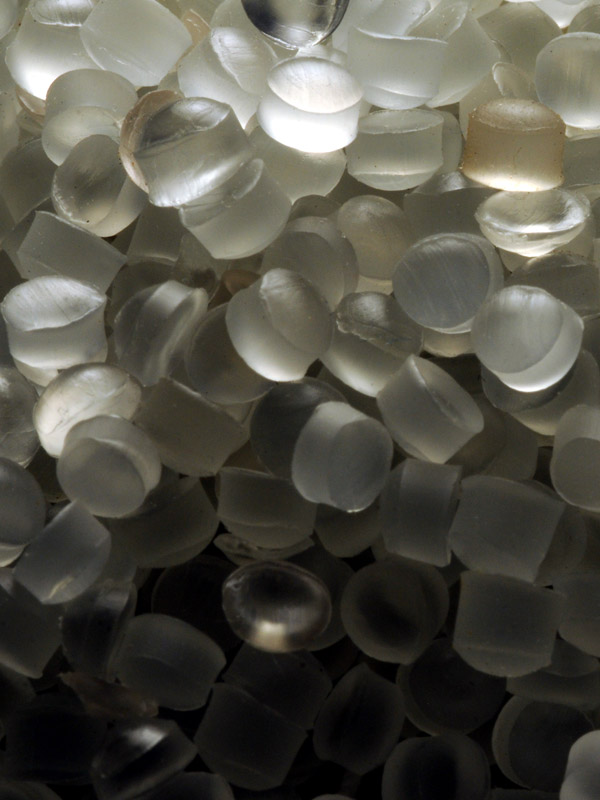
Extrusion
TENAX meshes and nets are produced through the process of polymer
extrusion.
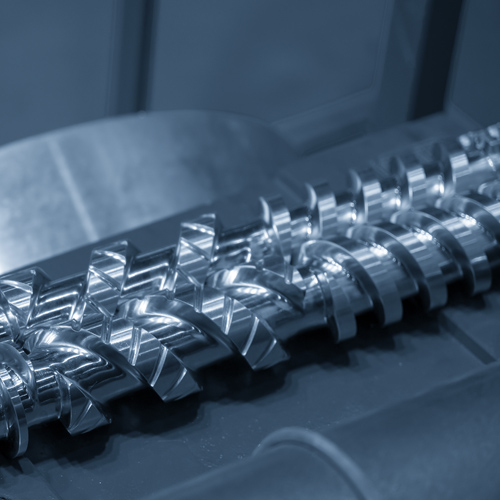
The two principal components of polymer extruders are
the extrusion "head" and the "die". The head
has the function of directing the liquid polymers towards the die.
The die - according to its shape and configuration - determines
the principal characteristics of the net or the perforated membrane
during extrusion.
The result of the extrusion process can be the
finished net or a semi-finished product ready for further stages
of manufacturing.
 |
|

Longitudinal orientation
The molecular orientation of the polymers provides a noticeable
increase in the tensile strength of the net. For this reason some
types of net undergo a process of longitudinal stretching during
which orientation of the molecules takes place. The nets manufactured
in this way (known as 'mono-oriented') have the benefit of improved
mechanical characteristics in the direction of the stretching.
Transversal orientation
This refers to a successive process similar to the above
but which takes place in a transverse direction. In this way the
net which has already been stretched in a longitudinal direction
is now stretched in the transverse direction - resulting in a product
which is both lightweight and extremely resistant in both directions.
Nets produced in this way are known as 'bi-oriented' or "stretched
nets". |
Calendering
Calendering is a process during which the thickness of the
product is regulated. This is achieved by passing the product between
two rollers at a measured pressure. |
|
Cutting
The cutting of the mesh can be carried out in a longitudinal
or transverse direction. The longitudinal slit creates flat nets
of various heights, whilst the transverse cut allows the client
to have, on request, pieces cut to measure to specific measurements. |
|
Selvedge
Some meshes can be manufactured with a smooth selvedge to
make handling and installation easier. |